Frost Flowers: One Name,Two Different Things
Dr. James R. Carter, Professor
Emeritus
Geography-Geology Department
Illinois State University, Normal
IL 61790-4400
What is in a
name? When people
see unusual displays
of ice in nature they create names to identify what they have found. There are at least two types of ice formations
that people associate with flowers. Then
they apply
prefixes such as frost and ice,
producing frost flowers and ice
flowers.
However, the names Frost Flower and Ice Flower have been applied to two distinctly different types of ice formations leading to confusion and erroneous explanations.
On one web
page an author confesses ignorance about the winter phenomenon of
'frost flowers' and sets out to explain the phenomenon. Without
permission the author used two of
my photos showing ice on plant stems and my explanation for
their formation to explain a different type of ice shown
in five photos from somewhere. Those five photos show growths
of ice on a frozen lake surface, supposedly in Finland. The author
does not tell us who owns those photos, nor do we know who the author
of this page is.
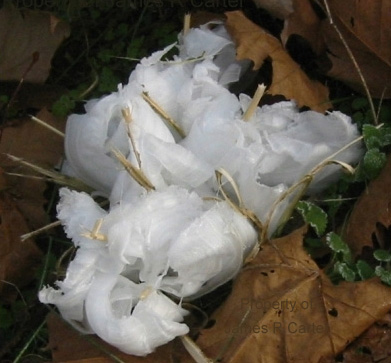
Below are two images taken from that web site. The image on the left shows my photo of ice growing on plant stems and the image on the right shows someone's photo of ice crystals on the frozen lake surface.
On the left
is a growth of ice from a group of plant stems, in this case in
Kentucky. On the right
are growths of ice on a frozen lake surface, supposedly in
Finland. Note how
different these flowers are.

On Frost Flowers or Ice Flowers on Plant Stems
The flowers of ice on plant stems are produced on only a few varieties of plants when the air temperature is below freezing but moisture in the stem is still liquid. The process of ice segregation that produces this type of ice flower also produces needle ice in some soils, pebble ice on some rocks and hair ice on some pieces of dead wood. In this process water moves through the stem to the ice surface, adding to the ice and pushing the ice away from the surface -- the plant stem in this case. This type of ice is not a product of frost but it often occurs concurrently with frost in the area.
Dr. Bruce Means was the first person in current times to publish broadly on these ice formations on plants and calls them Ice Flowers . At least two of the plants which support such growths of ice are sometimes called frostweed and thus many call the ice formations Frost Flowers. Many people who find such growths of ice often give them names that are descriptive of what they see. In addition to Ice Flowers and Frost Flowers you may see names such as Ice Ribbons, Ice Fringes, Ice Filliments, Rabbit Ice, Ice Castles, Frost Castles, and Ice Leaf. Dr. Robert Harms has proposed the name Crystallfolia based on Latin roots - basically translated as Ice Leaf.
|
|
|
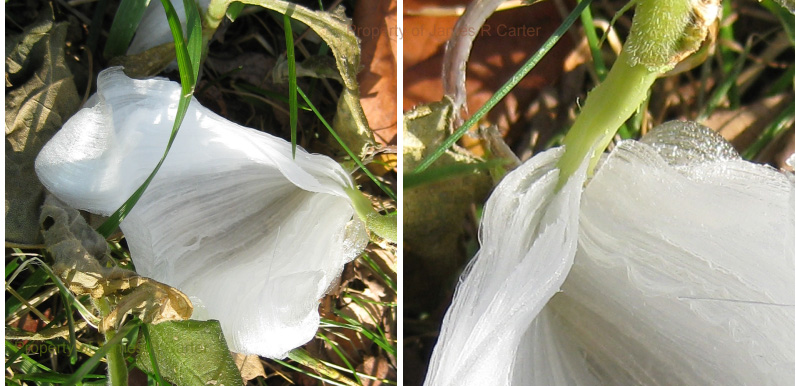
The Ice Flower above is on a stem of Verbesina virginica and forms what I call a scoop. The scoop from base to top is at least 5 cm in length. On the right the focus is on the way the curtains of ice seem to emerge from the stem, forming 3 almost parallel layers or streams. After extending out a little way the curtains of ice merge into one forming one side of the scoop. Note the stem and grass blades are still green telling us this is not an extremely cold environment. |
On Frost Flowers or Frost Crystals on Frozen Surfaces
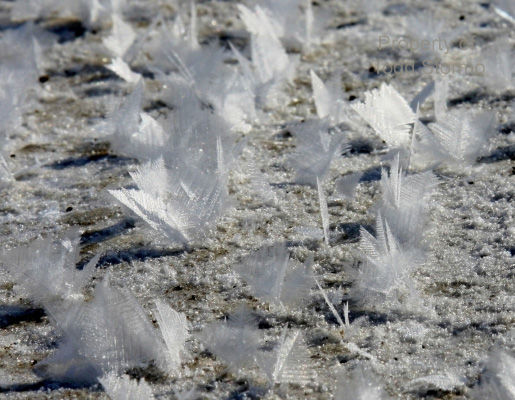
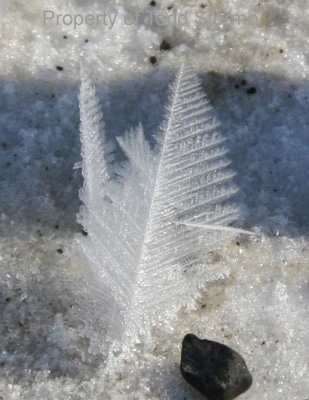
Dr. Todd Sformo of Barrow, Alaska, observed these flowers of ice on an April day with temperatures of about -15 C (5 F). These displays of ice are most appropriately called frost crystals because they grow by frost being deposited on ice crystals and thus adding to the growing crystals.
 |
 |
The SnowCrystals.com
web site explains the process and notes that the form of such crystals
varies with the temperature. The morphology diagram (click to
zoom)
on this site shows the different forms of frost
crystals as a function of temperature. These crystals from Alaska have a
dendritic form, which is characteristic of ice crystals that form at about
-15 C. That was
the temperature Dr. Sformo observed in Barrow when these crystals
formed. Note dendritic implies 'tree like', which
certainly applies here.
Some Big Errors
The Internet provides
access to a great amount of information but it also facilitates the
dissemination of a great amount of ignorance.
As noted above, someone
showed images of frost crystals
on a lake in Finland and took photos from my web page showing ice flowers
on plant stems and equated the two.
The person used my explanation for ice flowers produced by ice
segregation to explain frost crystals produced by an entirely different
process. Big
Error .
In winter 2013-14 The Weather Channel featured
frost flowers in two series on "the strangest weather on earth". At the start of the
segment entitled Rare Frost Flowers they
introduced frost flowers by showing video clips of ice growing from a
plant stem in Tennessee in November. They also
included an image of Hair Ice in this sequence, which is something quite
different and does not occur in Tennessee.
For an explanation of how these frost flowers occurred they
turned to an Arctic atmospheric scientist. She was not shown the images but
took on the task of researching frost flowers. She concluded they were products of the extreme cold
and demonstrated in the video how such extreme cold might produce blossoms of
ice.
I contacted the scientist who produced the explanation and introduced her to ice flowers on plant stems and Hair Ice. She was not familiar with these and acknowledged her explanation was not appropriate to these forms of ice. Currently, the online clip of Rare Frost Flowers on The Weather Channel does not include her explanation or any explanation as to their formation.
But, in that same series on The Weather Channel they have a segment entitled Arctic Blooms examining frost crystals forming on an ice surface and refer to these many crystals as both Ice Flowers and Frost Flowers. They do not offer an explanation of how they form but note that is some cases they contain large quantities of bacteria. The flowers shown here are frost crystals similar to those captured by Dr. Todd Sformo in Alaska.
Other Uses of Frost
Flowers
The name frost flower applied to ice on plant stems by ice segregation must go back many decades because a common name for at least two plants that produce such ice is frost flower. The frequently cited YouTube video of the growth of ice on stems of Verbesina virginica is titled Frost Flowers.
While such ice flowers are not an
accumulation of frost, these form when it is appropriate to have frost and
a crystal of frost may have been involved in starting the process of ice
segregation. Note in the
image above of the ice flower from Kentucky there is some frost on the
green leaves. But, I and
others argue it would be best to call such growths of ice "ice flowers"
and it has been proposed to call these "crystallfolia".
Robert Krulwich of NPR
produced a web page entitled Suddenly
there's a meadow in the ocean with flowers
everywhere
in support of his radio report about “
little protrusions of ice, delicate, like snowflakes.
They began growing in the dry, cold air "like a meadow spreading off in
all directions. Every available surface was covered with them." " He was told they are frost
flowers.
He goes on to offer an explanation of how these form. Note that the last photo on the page shows good examples of dendritic ice crystals.
The Two Forms of Frost Flowers
So, be aware there are at least two different things named
frost flowers. Both can be
quite attractive in their cold environments. Based on what we know one occurs
in the middle latitudes on a few varieties of plants when air temperatures
fall below freezing while the soil is still above freezing. The other form of frost flowers
occur in high latitudes when it is very cold and rather calm.
We will not be able to change the names people use for such
lovely displays of ice, but we can be aware that there are different
things named frost flowers.
Good luck on finding both types, and keep
warm.
On the World of Ice in the Age of the Internet and Digital Cameras
Now that we have the Internet and digital cameras we can see things that years ago were known only to a few local persons. Please share your images and details of ice formations in a responsible fashion. In the process we will gain a greater knowledge of these processes.
For other perspectives on ice see my web pages at http://my.ilstu.edu/~jrcarter/ice/ Feel free to contact me at jrcarter@ilstu.edu to share your photos of ice of this nature.
One of the many web pages of Dr. Jim Carter
