|
Some Ice Formations on White Crownbeard in Fall 2008
|
|||||||||||||||||||||||
|
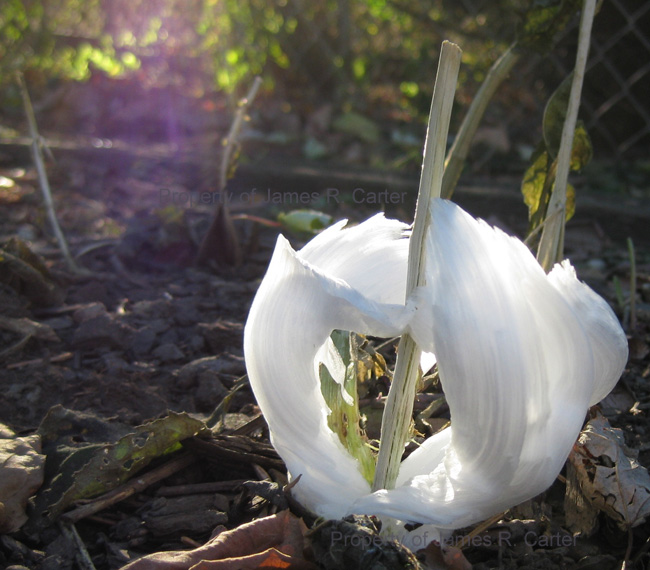
This is one of a collection of web pages showing what are sometimes called Ice Flowers, Frost Flowers and Ice Ribbons growing on vertical plant stems. On this page I am showing images of ice that grew on stems of White Crownbeard, Verbesina virginica, in my yard. These photos came from two places in my yard. One in and beside the buckets of dirt next to my house and the other in a corner plot near large trees and shrubs. This is but one of three pages showing ice in my yard this fall. Another shows ice formations in an open area on White Crownbeard stems and the other shows ice formations that grew on stems of Salvia and Vinca. The first photo was one of those lucky
shots where a shaft of sunlight penetrating between the branches of a Spruce
tree illuminated the ice ribbons and gave an ethereal glow in the background.
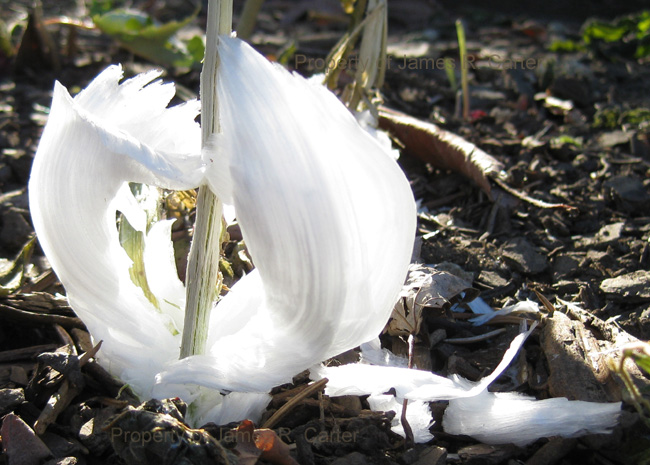
There were many ice formations in this area in the month of November. So, I kept returning to this area and captured photos of the ice in many stages of development. Of course, you cannot get a good photo until the Sun is high enough to illuminate the area, or you will have to use flash. In general, flash does not give very good results.
You can see some green leaves in the background of these photos showing that the ice occurs during that time that the cold air moves in and the plants are starting to die. The formation of the ice does not seem to be related to the stage in the life cycle of the plants but rather relates to those times when the moisture in the soil is still above freezing but the air temperature near the ground surface is below freezing. This situation prevails in the late fall in this part of the middle latitudes. This will not occur in spring because then the soil is likely to be frozen while the air temperatures are above freezing.
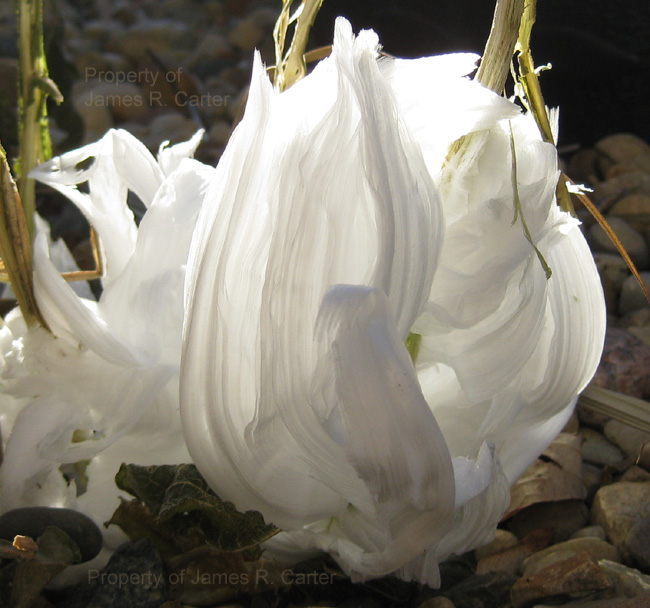
The photos above show the growth of ice from a single stem, but it is quite common to have ice growth from a complex of stems and merge together into a mass of ice ribbons, or what might be called ic flowers. It does not matter if the stems are intact or cutoff. This large mass of ice, perhaps 4 -5 inches (10 - 12 cm) tall, is a good example of the ice growing together from a complex of stems. Some of this ice reminds me of the complex formations of ice I found in northern Kentucky in 2005.
I like the ethereal nature of this image. I took many photos of this ice at a high resolution and have looked at the patterns of ice at many scales of resolution. The image above had to be greatly reduced to fit on the web page, and then it was cropped significantly. The image below is at a much higher resolution and gives a unique perspective.
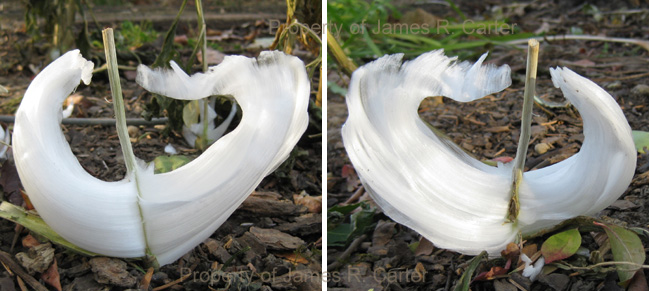
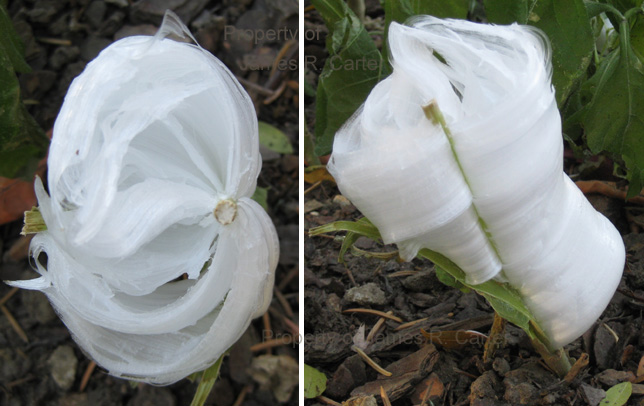
Speaking of lasting for hours, the two sets of photos below tell us something about the birth and death of these ice formations. This photo shows two views of the same ice formation. Here we see the ribbon nature of the ice, which in total gives the basis to call these ice flowers. This formation of ice was perhaps 4 inches (10 cm) tall.
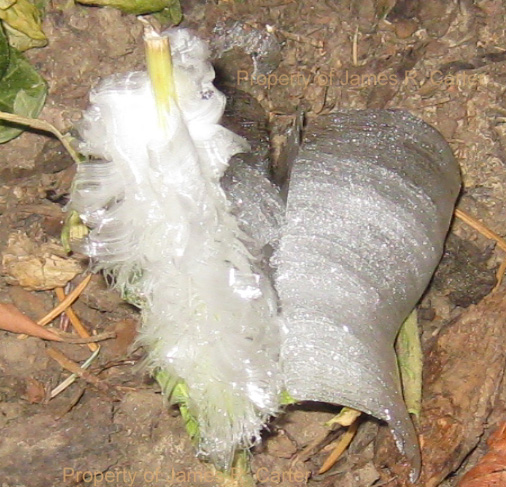
But this ice cannot last forever. Below we see the last remnant of the massive display of ice, now a fallen victim of warming. This is not from global warming but the diurnal cycle of warning and cooling during the day. On some days the ice lasts through the day and into the next. In some cases, it may go on for days if the temperature does not rise above freezing and direct sunlight does not fall on the ice. Below we see the juxtaposition of old and new ice.
However, in this case, I do not know if these sprites of new ice merged together because warm air moved in overnight and rain followed. The next morning it was all gone. But this photo tells us much about the processes of the growth and decay of ice on plant stems. Thank goodness for the Internet and digital cameras for they let us exchange information about these attractive ice formations. With time I hope to expand the web site to portray other views from this interesting season of ice. Feel free to contact me at jrcarter@ilstu.edu if you see any ice of this nature in your early morning outings. See http://www.jrcarter.net/ice/ for my master page on ice flowers / ice ribbons
|
|||||||||||||||||||||||
|
One of the many web pages of Dr. Jim Carter |

 This Web Page Created
with PageBreeze Free
Website Builder
This Web Page Created
with PageBreeze Free
Website Builder